
Quick answer
Looking up from below, run a ceiling fan counterclockwise in summer so it blows air down and creates a breeze. In winter, reverse it to clockwise on low speed to move warm air near the ceiling down into the room.
- Ceiling fans cool people, not rooms, and do not lower the room temperature.
- Turn the fan off and let the blades stop fully before changing the direction switch.
- Turn off power at the circuit breaker before any electrical work, and hire a licensed electrician when unsure.
It happens every year: the weather changes and you stare at your ceiling fan trying to remember which way it’s supposed to spin.
This is which way to turn a ceiling fan in winter vs summer:
Looking up at the fan from below: in summer, run it counterclockwise so it blows air down and you feel a breeze. In winter, reverse it to clockwise on low speed. That creates a gentle updraft that moves the warm air near the ceiling down into the room.
This article also shows how to change your fan’s direction using a switch on the fan motor, a remote, or a smart app.
Which Way To Turn a Ceiling Fan in Winter (or Other Cold Weather)
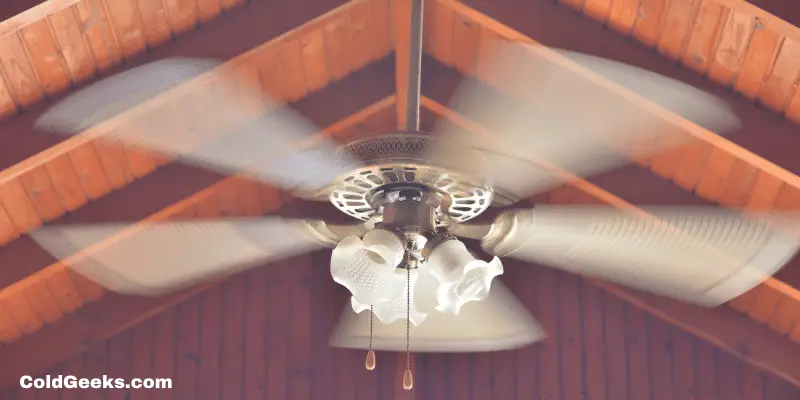
In cold weather, you want the warm air near the ceiling to circulate down into the living space.
Since warm air rises, reversing your ceiling fan will help push that warmth down into the room. Set your ceiling fan to spin clockwise at a low speed and it produces a gentle updraft that moves the warm air near the ceiling down into the room without a noticeable breeze.
This is why the U.S. Department of Energy and ENERGY STAR both say to reverse the fan to clockwise, on low speed, in winter.
Moving that warm air down can make the room feel more comfortable. Any savings come from turning the thermostat down a little while the fan runs, so remember to adjust it.
You might be surprised at the difference you feel.
Which Way To Turn a Ceiling Fan in Summer (or Other Warm Weather)
Most ceiling fans are capable of running in either direction, but many people don’t know that there is a difference. In the summer, you should always run your ceiling fan in the counter-clockwise direction.
This pushes air down and creates a breeze that makes you feel cooler. It does not lower the room temperature. As ENERGY STAR puts it, ceiling fans cool people, not rooms. The Department of Energy says that if you use air conditioning, a ceiling fan lets you raise the thermostat about 4°F with no reduction in comfort. Turn the fan off when you leave the room.
Spinning counterclockwise, the fan creates a downdraft, which you feel as a direct breeze. Clockwise does the opposite and pulls air up toward the ceiling.
This video covers ceiling fan direction for winter and summer:
How To Change the Direction of a Ceiling Fan
There are three main ways to change the direction of your ceiling fan:
- Use the switch on a fan with a pull chain
- Use a remote control
- Use a smart app
Change the Ceiling Fan Direction With a Switch
It’s easy to switch the direction of your pull-chain ceiling fan using a switch.
Turn the fan off and wait for the blades to come to a complete stop. Then check the fan body or light fixture for a small slide switch. If you need a ladder to reach it, set it on a solid, level floor.
On most ceiling fans the switch is on the motor housing, and it sets the direction the blades rotate. The exact location differs by model, so check the instruction manual for your fan.
There are usually two positions for the switch. One position turns the fan blades in a clockwise direction and the other turns the blades in a counterclockwise rotation.
Slide the switch all the way to the opposite position, then turn the fan back on.
Your ceiling fan will be spinning in the right direction in no time.
Change the Ceiling Fan Direction With a Remote Control
Changing the direction of your fan with a remote control is easy.
First, make sure that your fan is turned off and the blades are not moving. Next, find the reverse control on your remote or wall control. The control differs by brand. On Hunter remote-control fans, for example, you press and hold the fan button.
Use the control to reverse the fan, then turn the fan back on and check which way the blades turn. If you are not sure which button to use, check the manual for your model.
Your fan will now spin in the reverse direction.
Change the Ceiling Fan Direction With a Smart App
If you have a smart ceiling fan, you can change the direction with a smart app.
First, turn off the fan and let it come to a complete stop. Then open the app and select the fan you want to control. App layouts differ by brand. In Hunter’s SIMPLEconnect app, for example, you toggle the ceiling fan direction option.
Your ceiling fan will now spin in the direction you selected.
Which Way To Turn a Ceiling Fan on a Vaulted Ceiling
If your fan is on a vaulted ceiling, the advice is mixed. The Home Depot says to leave the fan on the counterclockwise setting year-round, because the fan is mounted so high that you are unlikely to feel any wind chill. Hunter says that running the fan clockwise in winter is especially helpful in rooms with vaulted ceilings.
Since the sources disagree, try both settings in winter on low speed and keep the one that feels more comfortable in your room.
Which Way To Turn a Ceiling Fan on a Low Ceiling
On a standard or low ceiling, follow the usual advice: counterclockwise in summer for a cooling breeze, and clockwise on low speed in winter to move warm air down. Check the clearance too. The Department of Energy says ceiling fans are only appropriate in rooms with ceilings at least eight feet high, and that fans work best when the blades are 7 to 9 feet above the floor and 10 to 12 inches below the ceiling.
This will help make your home more comfortable during different times of the year.
How to Tell Which Way Your Ceiling Fan Is Running
If you’re not sure if your ceiling fan is running in reverse, there are a few ways to tell.
Stand under the fan and look up at the blades. In the summer setting they turn counterclockwise, and you should feel a breeze directly under the fan. In the winter (reverse) setting they turn clockwise, and on low speed you should feel little or no breeze.
You can also check your ceiling fan’s switch.
Switch markings differ by brand, so do not rely on the switch position alone. Watch the blades to confirm.
Finally, you can check your fan’s remote control or a smart app.
If the fan is set on “reverse,” it means that your fan is running in reverse (clockwise).
Does Changing Your Ceiling Fan Direction Really Help?
The U.S. Department of Energy and ENERGY STAR both recommend it: counterclockwise in summer, and clockwise on low speed in winter.
But, the bottom line is that it doesn’t hurt to change the direction of your fan and it might help improve the comfort of your home during different times of the year.
So, why not give it a try? You can always switch back if you don’t like the results.
What To Do If Your Ceiling Fan Won’t Change Direction
If your fan will not reverse, the switch may be sitting between its two positions. Hunter advises pushing the reversing switch firmly left or right so that it is not positioned in the middle.
Turn the fan off, let the blades stop, then slide the switch fully to one side and try again.
If your ceiling fan still won’t change direction, there may be a problem with the wiring or the fan itself. Do not open the fan housing or touch any wiring with the power on. ESFI says to turn off the power at the circuit breaker before any electrical work and recommends hiring a qualified, licensed electrician.
Final Thoughts: Which Way To Turn a Ceiling Fan in Winter vs Summer?
A fan with a remote or app control makes the seasonal switch easier. The Home Depot notes that many remotes let you change a ceiling fan direction at the tap of a button.
Related posts:
- How To Bypass the Pull Chain on a Ceiling Fan
- What Is a Ceiling Fan Light Kit?
- What Is a Hugger Fan?
- What Is a Dual Mount Ceiling Fan?
Sources
U.S. Department of Energy (fans for cooling)
ENERGY STAR (ceiling fan installation and usage tips)
Hunter (ceiling fan direction guide)
Hunter (how to fix a ceiling fan)
The Home Depot (ceiling fan direction in summer and winter)
ESFI (DIY electrical safety)
ScienceDirect (Energy and Buildings journal)
Reviewed October 2026. We removed the claim that a fan can change the temperature by up to 10 degrees, corrected the explanation of how each direction works, replaced invented remote and app steps with maker guidance, and added safety steps, using the U.S. Department of Energy, ENERGY STAR, Hunter, The Home Depot and ESFI.